
Home / Magnetic level gauge
Magnetic level gauge
Simple structure, easy maintenance, direct reading — the most common way to show a liquid level on site. The hard part is not the model list; it is settling six questions before the drawings are cut, and confirming whether the device can be used with your medium at all.
Available product: it can be quoted and supplied directly. Structure, range and materials follow the duty; model and specification follow the technical agreement confirmed by both parties.

1. Working principle
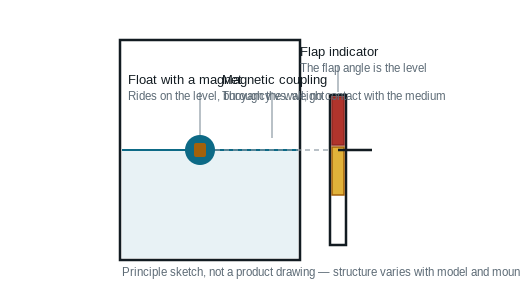
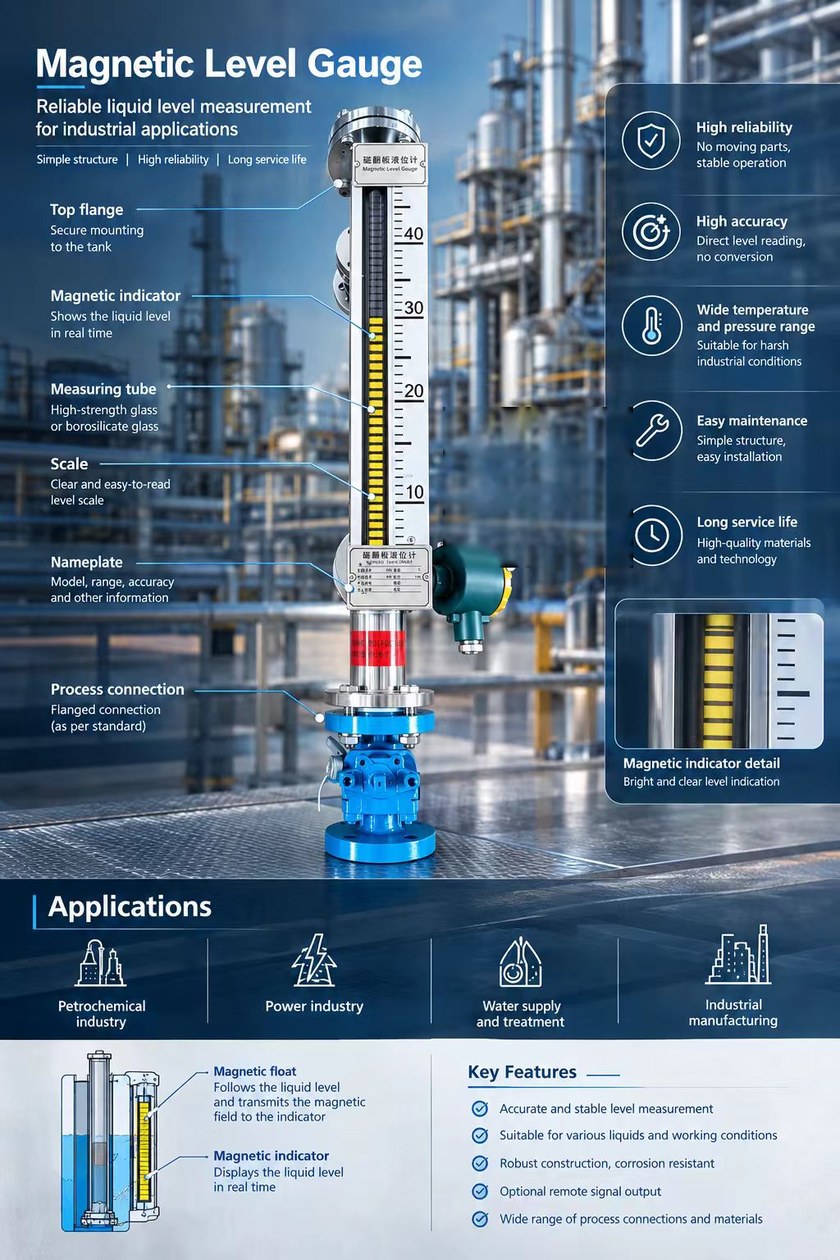
A float rides on the liquid level. The magnet sealed inside it transfers the magnetic pull to the indicator side through a linkage or directly through the vessel wall: the upper flap turns when attracted, the lower flap drops back, and the position of the flap is the level. No power, no moving part in contact with the medium, and no wetted sensing element to fail.
2. Common structural types
| Type | Features | Typical duty |
|---|---|---|
| Internal flap | Indicator mechanism inside the vessel, compact construction | Clean, atmospheric and ambient-temperature tanks |
| External flap | Indicator mechanism outside the vessel; can be extended with a sight window and lighting | Pressurised vessels, areas prone to condensation, long-distance viewing |
| Side / top mounting | Mounting direction decides where the range starts and how the unit is serviced | Chosen from the nozzle position and available working space |
| Column / float type | A float drives a linkage: direct reading and the simplest construction | Open tanks, low-pressure vessels, where high accuracy is not required |
| With alarm / with heat tracing | Adds upper and lower alarm switches; heat tracing for media that solidify | Duty needing an interlock, or media prone to crystallising |
The type is decided by the vessel, the medium and the operating requirements together — in most projects it is confirmed line by line in the technical agreement.
3. Six questions to settle before selecting
| Question | Why it must be answered | Common trap |
|---|---|---|
| Range and vessel geometry | The range has to cover normal level plus the highest and lowest safe levels, with margin | Sizing for normal level only — the device is useless once the tank runs high |
| Medium and duty | Temperature, pressure, density, viscosity and corrosiveness decide float and material | A plain carbon steel float in a corrosive medium leaks within months |
| Structure and mounting | Nozzle diameter, flange rating, side or top mounting, viewing direction | Flange class too low for the pressure — the assembly is not strong enough |
| Materials and sealing | 304 / 316L stainless, lining or coating (PTFE, PP), welds and sealing arrangement | Writing "stainless steel" without grade or lining |
| Output and alarms | Upper and lower alarm switches, remote output interface, interlock requirement | Alarm needed on site but no switch specified — retrofitting means cutting a nozzle |
| Codes and documents | Ex-proof certificate, material certificates, pressure test and nameplate | Bid requires a complete document set; one missing certificate means rejection on arrival |
4. Its limits: duties where it does not apply
The principle is simple, but there are hard boundaries. Exclude them at selection stage rather than after the unit is already installed.
- Ferromagnetic particles or contaminants in the medium: the float can be attracted and stick, or be held against the wall — such duties need a different principle.
- Highly viscous, crystallising or solidifying media: the float moves late or seizes; heat tracing may be needed, or a differential pressure / radar solution.
- Interface measurement: it indicates a level, not a density difference — the position of an interface cannot be judged from it.
- Closed and pressurised vessels: pressure and temperature change the immersed depth and the buoyancy of the float, so range and float density have to be checked together.
- Strongly corrosive media: protection relies on lining and coating; once the lining is damaged it becomes a leak path, so material and welding quality belong in the technical agreement.
5. Choosing against the alternatives
| Solution | Suits | Does not suit |
|---|---|---|
| Magnetic level gauge | Atmospheric, mild media; on-site reading; low maintenance | Ferromagnetic contaminants, viscous or crystallising media, continuous remote output or high accuracy |
| Differential pressure level | Closed pressurised vessels, usable density difference, continuous output | Large density swings, tap nozzles that tend to plug or scale |
| Radar level | High pressure, corrosive duty, condensation, non-contact and high accuracy | Higher investment and commissioning cost; also awkward with heavy foam and wall build-up |
Most plants combine local reading with remote alarm: the magnetic level gauge carries the local indication, alarm switches handle the alarm or interlock, and continuous measurement goes to differential pressure or radar.
6. What to send for a quotation
Duty
Medium name and corrosiveness, normal / highest / lowest level, working temperature and pressure, whether the medium contains ferromagnetic particles, whether it crystallises or solidifies.
Vessel and connections
Nominal diameter of the vessel, nozzle position and size, flange standard and pressure class, side or top mounting, sight window and lighting.
Range and output
Required range and indication accuracy, upper / lower alarm switches, remote interface and any ex-proof requirement.
Documents
Required documents with the shipment: material certificates, pressure test record, ex-proof certificate (if applicable), nameplate and manual language version.