
Home / Level instruments
Level instrument selection
The flow may be right and the tank still has to be measured. Level has more than one principle behind it, and picking the wrong one is not a matter of a little accuracy — it simply will not fit or will not work. This page sets out the three main routes and their hard boundaries, so the option that cannot be used is ruled out before the selection starts.
1. The three routes at a glance
| Route | How it measures | Typical output | Maintenance | Main limits |
|---|---|---|---|---|
| Magnetic level gauge flap / float type |
A float rides the level; the magnetic pull crosses the wall and drives a flap | Local reading + switch alarm | Low; failure shows as "reading frozen", which is easy to judge | Ferromagnetic contaminants can bind the float; viscous or crystallising media disable it |
| Differential pressure level | Pressure taps convert the vessel-to-atmosphere (or vessel-to-vessel) difference into level | Continuous 4–20 mA / HART | Moderate; taps can scale or plug, so flushing is needed | Depends on a density difference; large density swings give large errors; pressurised vessels need compensation |
| Radar level | Radar travel time to the liquid surface, non-contact | Continuous 4–20 mA / HART | Low; no wetted parts, but commissioning is required | Foam, wall build-up and very low dielectric constant weaken the reflection; investment and commissioning cost |
These are not substitutes for one another. Most plants combine local display, remote alarm and continuous measurement, and each instrument covers its own part of that.
2. Selection path: ask these four questions in order
① Is there anything ferromagnetic in the medium?
With iron swarf, mill scale or magnetic particles, the magnetic level gauge is ruled out, leaving differential pressure and radar.
② Does the medium crystallise, solidify or coat the wall?
With viscous or crystallising media the float seizes and the radar wave gets masked — either heat trace it or go differential pressure.
③ Is a local reading enough, or do you need a continuous signal?
For on-site reading and alarms, the magnetic level gauge is the simplest answer. Continuous signal, trending or interlock needs a transmitter type instrument.
④ Is the vessel open or closed and pressurised?
In a closed pressurised vessel, the DP method needs density and pressure compensation, and a magnetic gauge needs float density and range checked; radar is unaffected by vessel pressure.
3. Mapping the common duties
| Duty | Usual route | What matters |
|---|---|---|
| Atmospheric tank, local indication | Magnetic level gauge | Simplest structure and lowest maintenance; upper and lower alarm switches cover most requirements |
| Closed pressurised vessel | DP level / radar level | DP needs pressure and density compensation; a magnetic gauge needs float buoyancy checked |
| Strongly corrosive medium | Radar level with PTFE horn | Non-contact avoids the leak path created by a damaged lining |
| Highly viscous, crystallising medium | DP level + heat tracing | A magnetic float can freeze in place; radar suffers from build-up |
| Interface measurement (oil/water, water/steam) | DP or radar, depending on contrast and duty | A magnetic level gauge indicates level height; it cannot tell you where the interface is |
| Remote signal, interlock and trending | DP / radar plus alarm interlocks | The magnetic gauge's switch output is for limit alarms, not continuous control |
The table gives the level of logic that rules options out; range, bore, materials and mounting still depend on the actual duty.
4. Magnetic level gauge (the route we lead with)
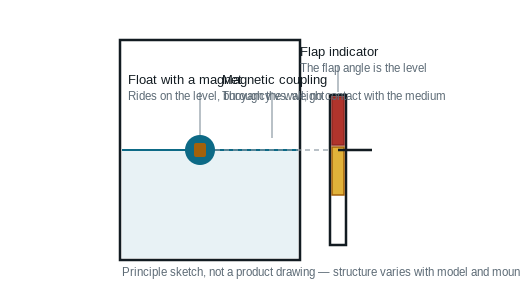
The magnetic level gauge is an available product and can be quoted and supplied directly; structure, range, materials and alarm options follow the duty, and the model follows the technical agreement.
Why it is often chosen
- No power, no wiring: nothing to connect and no ex-proof certification burden, which keeps installation simple on site.
- No contact with the medium: the indicator sits outside the vessel, so a corrosive medium only touches the float and the isolation parts.
- Direct reading: the red and yellow flaps are unmistakable, no training needed for shift handover or patrol.
- Little maintenance: no electronics, no electronic failure modes, and the symptom of a fault is obvious.
5. Alarms, interlocks and companion instruments
Switch alarms
Upper and lower alarm switches give a direct switching signal for high-level interlocks, pump start/stop and remote signalling. A magnetic level gauge is normally switch output, not continuous.
Transmitters and remote signals
DP and radar instruments output 4–20 mA / HART into the DCS or PLC for display, recording and interlock. Model and range follow the duty.
Heat tracing
Media that solidify need trace heating or frost protection, and the traced extent belongs in the technical agreement — otherwise the float blocks up and the plant stops in winter.
Taps and mounting parts
For DP: pressure taps, flanges, impulse lines and purging. For magnetic gauges: flange class, side or top mounting, sight window and lighting — all confirmed line by line in the selection sheet.
6. What to send for a quotation
Medium and duty
Medium name and corrosiveness, density, viscosity, working temperature and pressure, whether it contains ferromagnetic particles, whether it crystallises or solidifies.
Vessel
Open or closed and pressurised, nominal diameter, material, design pressure, nozzle position and count, flange standard and pressure class.
Level and range
Normal, highest and lowest level, the required indication accuracy, and whether you want a level or an interface.
Output and documents
Alarm switches, continuous output and communication protocol, any ex-proof requirement, and the documents needed on delivery (material certificates, pressure test record, ex-proof certificate).