
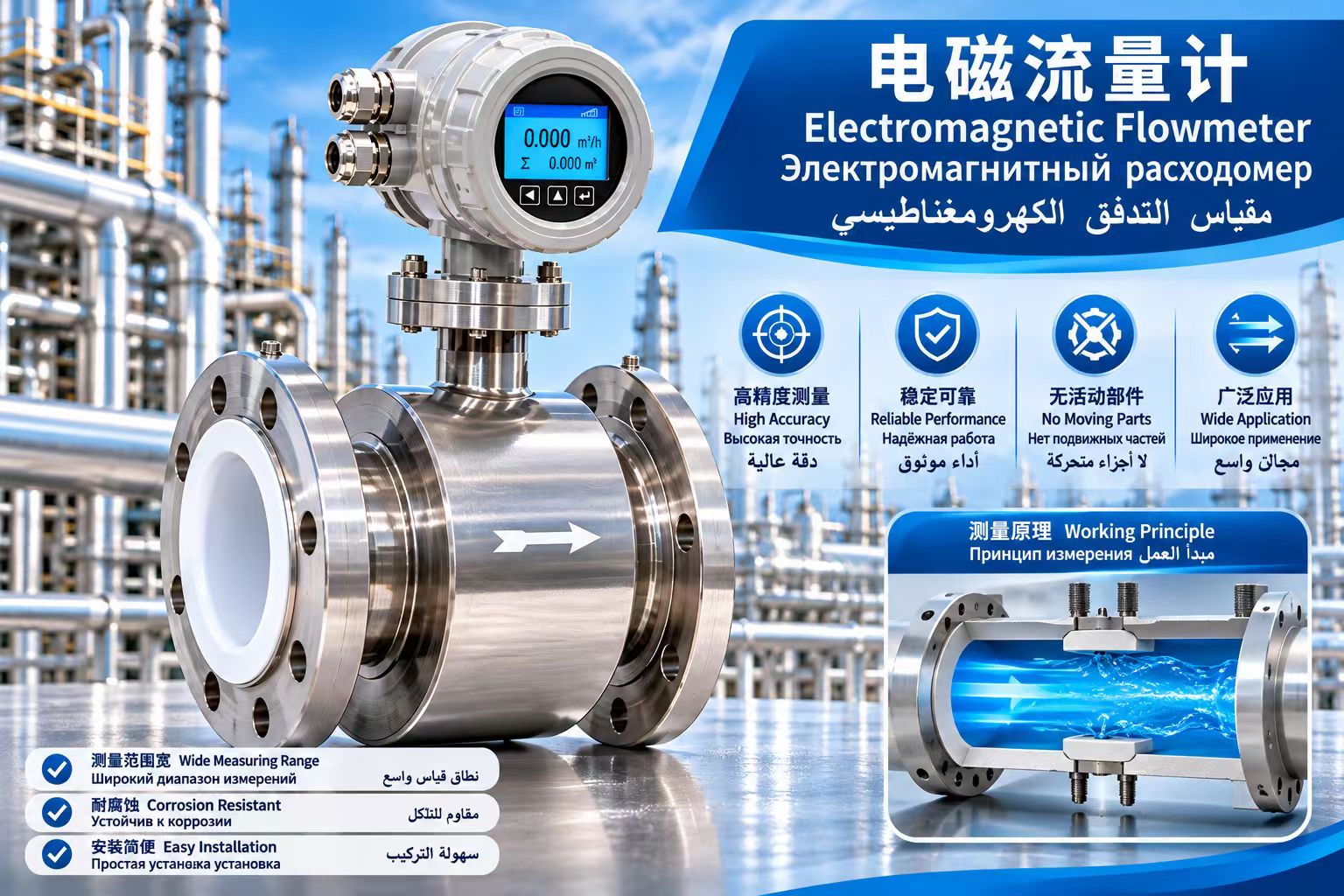
SKLD electromagnetic flowmeter
Electromagnetic flowmeter: choosing DN and range
The measurement itself is simple — Faraday induction makes the voltage proportional to mean velocity, so the meter measures volumetric flow regardless of temperature, pressure, density or viscosity, and needs one calibration. The difficult part is getting DN and range right.
The selection order
Selection does not start with "how big a bore do I need". It starts with the two parts that touch the medium. The SIKE SKLD order is 5-4-3-2-1:
- medium temperature + working pressure → liner (many duties are decided here);
- corrosiveness + particulates → electrode;
- process flow → DN → bore and pressure class;
- control system protocol → transmitter;
- installation environment → protection class and explosion-proof type.
Get the order wrong and you get the classic rework: material fixed before the flow is known, or a transmitter whose protocol does not match the DCS.
Using the 1 m/s table to pick DN
The usual basis is the flow corresponding to 1 m/s:
DN100 corresponds to 28.3 m³/h, DN500 to 708 m³/h. Any other velocity is a simple multiple of that table. In practice you back-calculate the DN so that the usual flow sits in the middle of the recommended range — not at its upper end.
| DN | Q at 1 m/s (m³/h) | Recommended range (m³/h) | Max measurable (m³/h) |
|---|---|---|---|
| 50 | 7.08 | 1.7 – 57 | 0.708 – 70.8 |
| 80 | 18.1 | 4 – 145 | 1.81 – 181 |
| 100 | 28.3 | 7 – 226 | 2.83 – 283 |
| 150 | 63.7 | 15 – 510 | 6.37 – 637 |
| 200 | 113 | 27 – 904 | 11.3 – 1130 |
| 250 | 177 | 42 – 1416 | 17.7 – 1770 |
| 300 | 255 | 61 – 2040 | 25.5 – 2550 |
| 400 | 453 | 109 – 3624 | 45.3 – 4530 |
| 500 | 708 | 170 – 5664 | 70.8 – 7080 |
| 600 | 1019 | 245 – 8152 | 101.9 – 10190 |
| 700 | 1387 | 333 – 11096 | 138.7 – 13870 |
Source: appendix 1 and 2 of the SIKE SKLD manual. DN800 and above are proportional estimates; higher pressure classes are available on request.
Recommended range vs maximum measurable flow
The maximum measurable flow is a hardware limit. Running at it is possible but accuracy and stability suffer clearly. What you should use is the recommended range, near its middle, keeping about a third of the range in reserve.
- usual flow in the middle of the recommended range → good range utilisation;
- close to the lower end → careful: below 0.3 m/s viscosity effects grow;
- close to the upper end → warning: above 10 m/s liner and electrode wear accelerates;
- beyond the maximum measurable → wrong, the DN must be increased.
The SKLD turndown reaches 150:1, so small flows are not the problem — provided the velocity does not drop too low.
Set the range to the maximum flow
This is the most common commissioning error: the process says "we usually run at 40 m³/h", so the transmitter is set with 40 m³/h as full scale — and then alarms on over-range as soon as production steps up. The range must be set to the maximum process flow, with the usual operating flow written on the nameplate. Keep the two apart.
Liner and electrode: medium first, then temperature and pressure
| Medium | Liner | Electrode |
|---|---|---|
| General acids / alkalis | PTFE | Stainless steel |
| Slurry / coal slurry | PU | Tungsten carbide |
| Seawater / chloride | PTFE | Titanium |
| Strong acid (HCl) | PTFE or FEP | Hastelloy (HB) |
| Hot strong acid | FEP | Tantalum (Ta) |
| Steam (permeation) | Reinforced PFA | Stainless steel |
| Neutral water (economy) | Neoprene | Stainless steel |
Source: SIKE SKLD liner/electrode selection matrix. Exact grades and temperature limits are confirmed in the technical agreement.
Three preconditions people forget
- Conductivity ≥ 5 μS/cm. That is the floor of the principle. Ultra-pure water, distillate and fuels are not conductive — an EM meter simply cannot work there.
- Straight run: 5 DN upstream, 2 DN downstream; the two electrodes must sit on the same horizontal line, which is regularly forgotten on vertical installations.
- The signal cable shield must be earthed, otherwise interference arrives directly in the flow signal.
Most site alarms are not a failed instrument: the empty-pipe, excitation and over/under-range alarms cover most cases. Check full pipe, then the coils, then the range setting — seven out of ten problems are solved that way.
Sources: SIKE SKLD electromagnetic flowmeter manual (豫制 02000040, 2016F103-41), chapters 3–6; JB/T 9248-1999.
Put your maximum process flow into the EM flowmeter lookup, or send me the data and I will return DN, range and materials.